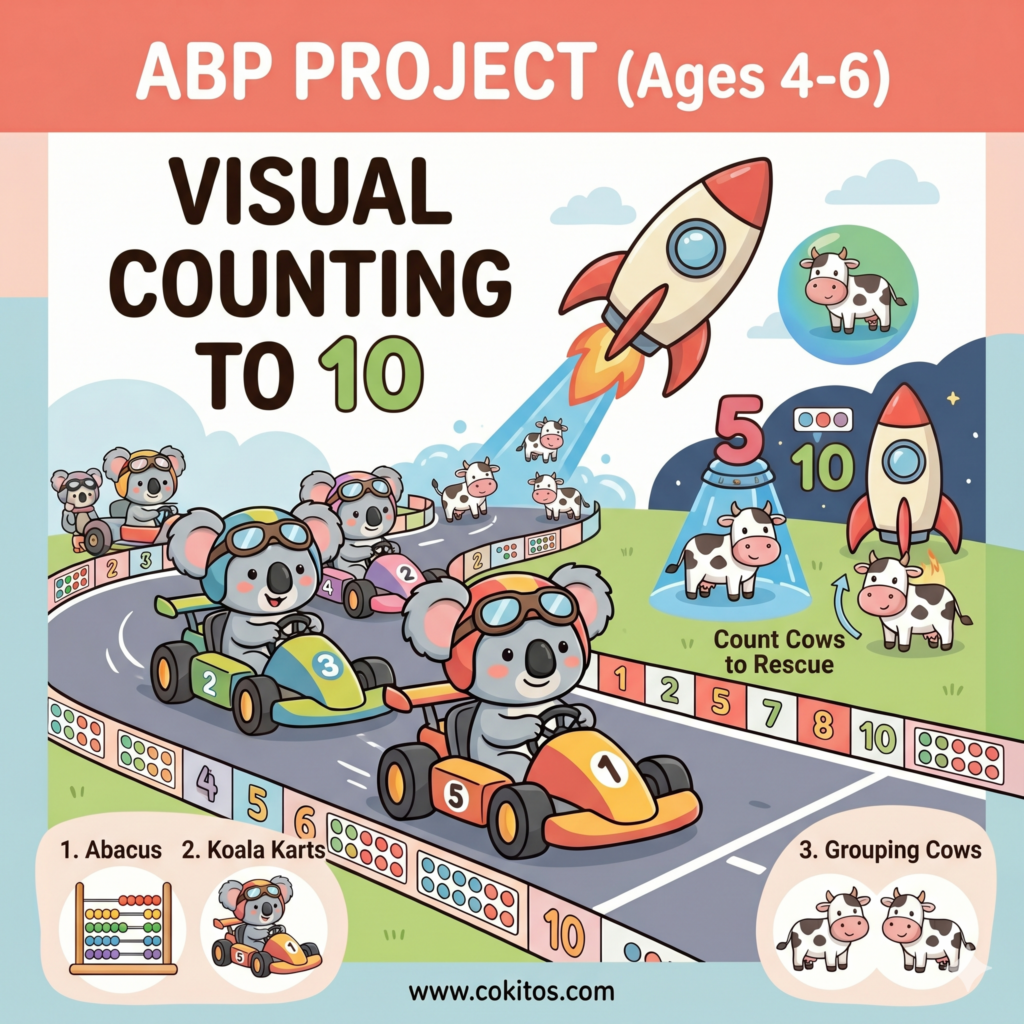
PBL PROJECT: Visual Counting, Number Breakdouwn (5 and 10) and Symbolic Representation (Ages 4-6)
Digital Didactic Materials Project Based Learning Worksheets with online games Cokogames 0
VISUAL COUNTING, NUMBER BREAKDOWN (5 and 10), and SYMBOLIC REPRESENTATION
Games to play: (1) Virtual Abacus, (2) Koala Kart Race, (3) Group the Cows
1. PROJECT CONTEXT
This project stems from the need to strengthen early number learning in preschool and the early grades of elementary school, where many children struggle to understand the true meaning of quantities beyond simply memorizing numbers.
At these ages, math learning is much more effective when supported by visual, hands-on, and playful activities. Therefore, a game-based approach is proposed that allows students to construct the concept of numbers through observation, repetition, and interaction.
The project combines different interactive activities with a shared pedagogical foundation: representing numbers using structures of 5s and 10s, which facilitates understanding of the basis of the decimal system. This visual organization helps children recognize numerical patterns, break down quantities, and develop initial mental math strategies.
Through games such as races with characters (koalas in go-karts) or digital abacus-style activities, students practice counting to 10, number-quantity associations, and identifying numbers based on graphical representations. The narrative and competitive elements increase motivation, while the repetition of patterns promotes the internalization of learning.
2. CHALLENGE OR GUIDING QUESTION
How can we help the koalas win a big go-kart race while learning to understand numbers using groups of 5 and 10?
3. LEARNING OBJECTIVES
- Understand the concept of numbers through visual and hands-on representations.
- Count objects accurately up to 10, associating quantity with numerical symbols.
- Recognize and use groups of 5 and 10 as a basis to facilitate counting.
- Break down numbers less than or equal to 10 into groups of 5 and remaining units.
- Identify which number is represented by a given quantity of elements in different visual configurations (abacus, dots, groupings).
- Develop initial mental calculation strategies based on simple groupings.
- Improve attention, observation, and speed in identifying quantities.
- Encourage problem-solving through play and experimentation.
- Boost motivation for mathematics through game dynamics, storytelling, and challenges.
- Practice decision-making in interactive game contexts (choice, response, verification).
4. PROJECT DEVELOPMENT
Phase 1: Engagement and Motivation (Introduction to the Challenge)
The project’s story is presented: the koalas are participating in a big go-kart race and need to master numbers in order to move forward and win. Through a simple narrative, the challenge of learning to count, recognize quantities, and use structures of 5 and 10 is introduced. An initial exploration of prior knowledge takes place: counting objects, recognizing numbers, and playing with visual examples.
Phase 2: Exploring Numbers (Counting to 10)
Students work on interactive activities where they must count visually represented elements (dots, animals, objects). The number-quantity association is reinforced through drag-and-drop exercises and selecting answers. Here, the use of structures organized in rows of 5 is introduced to facilitate counting.
Phase 3: Building the concept of 5 and 10 (abacus game)
The concept of grouping is explored in greater depth. Students learn to view numbers as combinations of 5 plus remaining units. The online digital abacus game and visual representations where elements are colored or grouped in sets of 5 are used. The goal is for students to begin recognizing numerical patterns without having to count one by one.
Phase 4: Application in the racing game (Koala Karts)
Students apply their knowledge in a dynamic game where they race against koalas in go-karts. To move forward, they must correctly answer questions about quantities, identify numbers represented in visual structures, and demonstrate speed in counting. Each correct answer propels the character forward in the race.
Phase 5: Final Game: The Cows’ Space Mission (Fun Bonus)
To wrap up the project, a final narrative challenge is presented: a spaceship has abducted cows, and students must rescue them and quickly organize them to return them to Earth.
Students must group cows into sets of 5 or 10, as indicated, helping to sort them before the spaceship takes off again. This final game reinforces number decomposition in a playful way and adds an element of surprise and humor to the project.
Phase 6: Wrap-up and Reflection
We review what has been learned: how to count faster, how to use groups of 5 and 10, and how the games have helped them better understand numbers. Students share which strategy they found most useful and which game they liked best.
- 5. KEY ACTIVITIES RELATED TO PLAY
- Visual counting up to 10
- Activities in which children count objects, dots, or animals displayed on the screen, reinforcing the relationship between quantity and number.
- Number–quantity association
- “Drag-and-drop” exercises in which children must match a number with the correct representation of items.
- Recognition of groups of 5 and 10
- Activities to quickly identify groups organized in rows or blocks of 5 and 10, without counting one by one.
- Number decomposition
- Games that demonstrate how a number can be formed by adding 5 to another number (for example, 8 = 5 + 3), using visual representations.
- Racing Game (Koala Karts)
- A gamified activity in which students answer math questions to advance in a race, reinforcing calculation speed and attention.
- Interactive visual abacus
- Use of a digital abacus with 5 wires and 10 beads per row, colored in groups of 5, to represent numbers and identify the quantity being formed.
- Identifying represented numbers
- Observation activities where students must interpret a visual representation (dots, abacus, or groupings) and state what number it is.
- Final Grouping Game (Creative Bonus)
- A fun activity where students must group cows into sets of 5 or 10 to save them after an alien abduction, reinforcing numerical organization in a playful way.
- Decision-making in game settings
- Choosing answers, strategies, or actions within games to advance or win the game.
- Reinforcing attention and quick response
- Activities that develop quick observation, concentration, and the immediate identification of quantities.
6. SKILLS BEING DEVELOPED
- Mathematics and Science, Technology, and Engineering (STEM) Skills
- Students develop the ability to use numbers in real-world and visual contexts, count to 10, break down numbers, and understand basic structures of the decimal system through groupings of 5s and 10s.
- Digital Competence
- Use of interactive online games, drag-and-drop interfaces, and digital activities that require interaction, selection, and decision-making in virtual environments.
- Linguistic Communication Competence
- Understanding of instructions, interpretation of simple math problems, and use of basic numerical language to express quantities and results.
- Personal, social, and learning-to-learn skills
- Development of attention, concentration, and autonomy in solving challenges, as well as the ability to improve through trial and error in games.
- Sense of initiative and entrepreneurial spirit
- Decision-making during games (choosing answers, race strategies, solving challenges), fostering initiative and basic planning.
- Cultural awareness and expression (playful-narrative approach)
- Participation in stories and games with characters (koalas, cows, space races) that foster imagination and expression through symbolic play.
- Competence in logical-mathematical thinking
- Recognition of patterns, groupings, numerical relationships, and basic mental calculation strategies based on visual structures.
7. ASSESSMENT
Assessment is approached as a continuous, formative process based on observing students’ progress throughout all project activities.
🔹 Assessment Criteria
- Recognizes and correctly counts quantities up to 10.
- Accurately matches numbers and quantities in visual representations.
- Identifies patterns of 5 and 10 as a basis for quick counting.
- Breaks down simple numbers into groups of 5 and remaining units.
- Correctly interprets representations using an abacus, dots, or groupings.
- Solves math challenges in game contexts (races, quick questions).
- Actively participates in the proposed activities, showing interest and motivation.
- Progressively improves in speed and accuracy in counting tasks.
🔹 Assessment Tools
- Direct observation while students use interactive games.
- Recording of responses in digital activities (correct/incorrect answers).
- Simple rubrics for performance on key tasks (counting, matching, breaking down).
- Tracking progress in the games (speed, accuracy, level advancement).
- Guided self-assessment using simple questions: What have I learned? What was easiest or hardest for me?
🔹 Assessment Moments
- Initial: Assessment of prior knowledge of numbers and counting.
- Formative: Ongoing monitoring during games and activities (Koala Karts, abacus, challenges).
- Final: Completing the final challenge of grouping cows (5 or 10) as a summary of what has been learned.
🔹 Evidence of learning
- Correct answers in interactive activities.
- Ability to recognize numbers represented visually.
- Spontaneous use of groups of 5 and 10.
- Active participation in games and solving final challenges.
8. FINAL REFLECTION
- Which activity did you like best about the project? Why?
- Which was easier for you: counting with pictures or with numbers?
- How does grouping in sets of 5 or 10 help you count faster?
- What did you learn about numbers that you didn’t know before?
- In the koala game, what did you have to do to make your character move forward?
- Did the abacus help you understand numbers better? How?
- Did you make any mistakes? What did you do to correct them?
- If you had to explain to a classmate how to count to 10, what would you say?
- What strategy do you use now to count faster?
- What would you like to continue practicing from this project?